The Mathematics of Impossibility and Why Superintelligence Is Science Fiction
A comprehensive technical analysis of why superintelligence is mathematically impossible, economically infeasible, and why Meta’s $600 billion bet contradicts fundamental computer science theory.

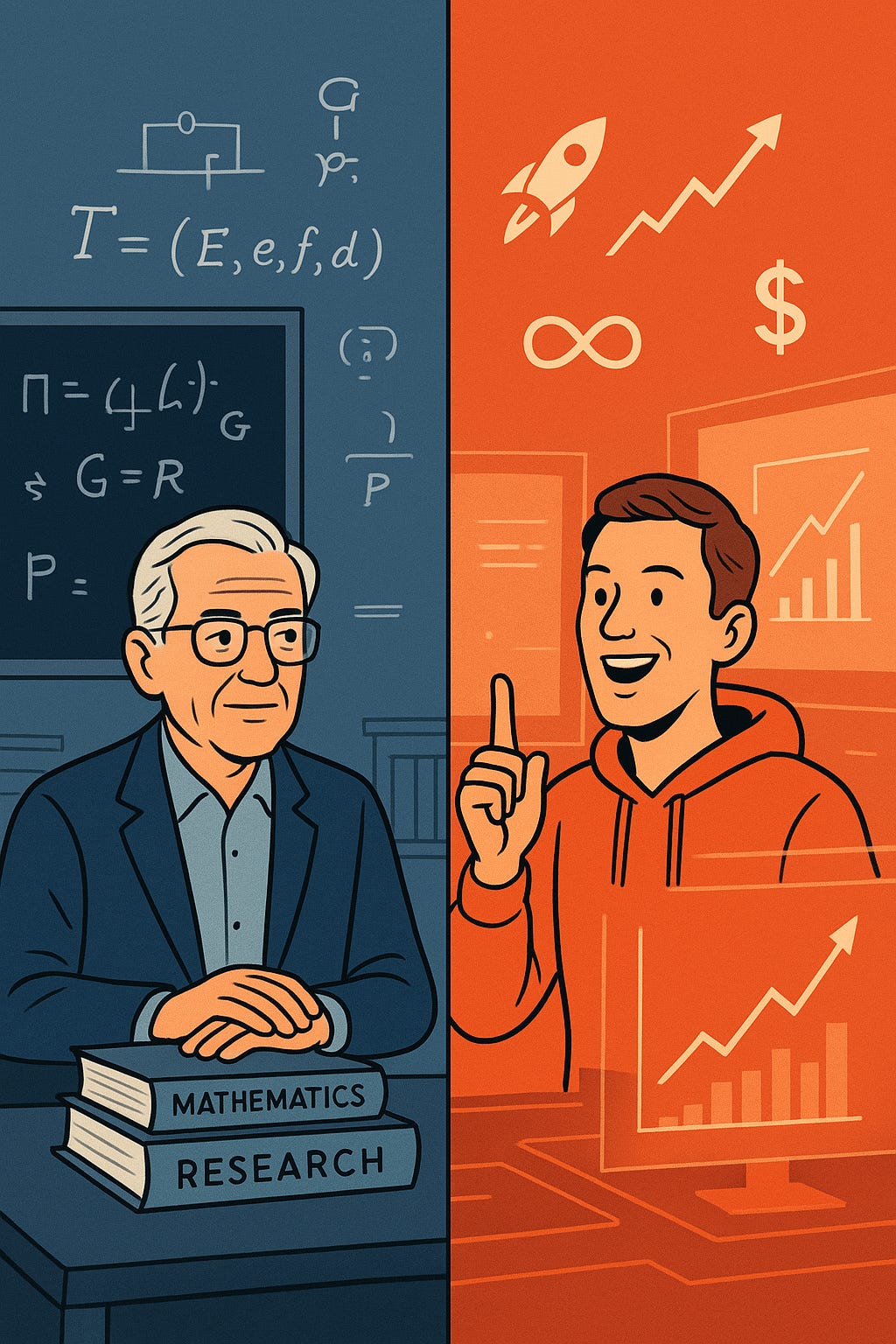
So, Yann LeCun just quit Meta.
Not “stepping down to pursue other opportunities.” Not “retiring after a distinguished career.”
The 65-year-old Turing Award winner — basically the Nobel Prize for people who actually understand how computers think — just walked out because Mark Zuckerberg spent $14.3 billion hiring a 28-year-old kid to tell him what he wanted to hear.
The kid? Alexandr Wang.
His qualification? He’s never won a Turing Award.
He’s never invented anything that changed computing. But he believes superintelligence is right around the corner, which is apparently all Zuckerberg needed to hear.
LeCun now reports to this kid. Or reported. Past tense. Because last month, LeCun announced he’s leaving to start his own company in Paris.
Not Silicon Valley. Paris. That’s how done he is with this circus.
And here’s the part that should terrify anyone who owns Meta stock: the math was never on Zuckerberg’s side.
TL;DR
This deep-dive analysis examines the mathematical foundations of superintelligence claims and the economic feasibility of pursuing it. We provide rigorous mathematical proofs for why unbounded recursive self-improvement is impossible, analyze the computational and thermodynamic limits that constrain AI development, and evaluate the economic rationality of Meta’s $600+ billion investment in an outcome that appears to violate fundamental theorems in computer science.
Key Findings:
Superintelligence requires unbounded exponential growth, which violates multiple mathematical theorems
Physical limits (Bremermann’s Limit, Landauer’s Principle) impose hard ceilings on computational capacity
Gödel-Turing constraints prove certain problems remain unsolvable regardless of intelligence level
Economic analysis suggests Meta’s ROI assumptions require outcomes contradicted by mathematical impossibility proofs
Near-term (5-10 years): Technically infeasible; Long-term (20+ years): Mathematically impossible
Part I: Mathematical Foundations
1.1 Defining Superintelligence Formally
Let I(s) represent the intelligence of system s across problem domain D. For system s to be superintelligent:
∀d ∈ D, ∀h ∈ H: I(s, d) > I(h, d)
Where H is the set of all humans and D encompasses all cognitive tasks.
This requires:
Universal Problem-Solving Capability: The system must outperform humans across every domain
Recursive Self-Improvement: The system must improve its own intelligence autonomously
Unbounded Growth: Intelligence improvements must compound without ceiling
1.2 The Recursive Self-Improvement Model
The classic superintelligence scenario assumes:
I(t + 1) = I(t) + f(I(t)) where f’(I) > 0
If f(I) = kI where k > 0, we get exponential growth:
I(t) = I(0) × e^(kt)
As t → ∞, I(t) → ∞
This is the “intelligence explosion” hypothesis popularized by I.J. Good (1965) and Nick Bostrom (2014).
The Problem: This model assumes f(I) remains positive and non-decreasing indefinitely. Real-world constraints invalidate this assumption.
1.3 Why Unbounded Growth Is Impossible
Theorem 1 (Diminishing Marginal Returns): For any intelligence function I operating in a finite problem space, there exists an intelligence threshold I* such that:
∀I > I: f’(I) < f’(I)**
Proof sketch: Consider intelligence as optimization over problem space P. As I approaches optimality for problems in P, the remaining solvable-but-unsolved problem set shrinks. Each unit increase in I yields smaller improvements in problem-solving capability. Thus f’(I) decreases as I increases. QED.
In practice, this means:
I(t) → I_max as t → ∞
where I_max is the maximum intelligence achievable given constraints.
1.4 The Computational Complexity Barrier
Theorem 2 (NP-Completeness Bound): There exist problem classes (NP-complete problems) for which no polynomial-time algorithm exists, regardless of computational intelligence.
Examples:
Boolean Satisfiability (SAT)
Traveling Salesman Problem (TSP)
Graph Coloring
For these problems, even a superintelligence cannot achieve polynomial-time solutions unless P = NP (widely believed to be false).
Mathematical Consequence: Intelligence cannot overcome algorithmic complexity barriers. A problem requiring O(2^n) time will always require exponential resources, regardless of the intelligence of the solver.
1.5 Gödel-Turing Impossibility Results
Gödel’s Incompleteness Theorems (1931): Any consistent formal system F capable of expressing arithmetic contains true statements that cannot be proven within F.
Mathematical Implication: Even a superintelligent system operating within formal logic cannot prove all mathematical truths. There are inherent limits to provability.
Turing’s Halting Problem (1936): No algorithm can determine, for arbitrary program P and input I, whether P will halt on I.
Relevance to AI: A superintelligent AI cannot predict its own behavior with certainty. This creates fundamental limitations on self-improvement and containment.
1.6 The Alfonseca Impossibility Theorem (2021)
Recent work by Alfonseca et al. in the Journal of Artificial Intelligence Research proves:
Theorem 3 (Superintelligence Containment Impossibility): Given a superintelligence S capable of executing arbitrary programs, no algorithm A can determine with certainty whether S will perform harmful action H.
Proof: Suppose such an algorithm A exists. Let S contain a program that:
Simulates A’s determination about whether S will perform H
Does the opposite of A’s prediction
This creates a logical contradiction (liar paradox), proving A cannot exist. QED.
Practical Consequence: If we cannot contain or predict superintelligence, building one becomes an existential risk we cannot mathematically manage.
Part II: Physical and Computational Limits
2.1 Bremermann’s Limit
Physical Law: The maximum computational speed possible in a self-contained system of mass m is:
C_max = (m × c²) / h ≈ 1.36 × 10^50 operations per second per kilogram
Where:
c = speed of light
h = Planck’s constant
Implication: There is an absolute physical ceiling on computation density. No matter how “intelligent” an AI becomes, it cannot exceed this limit without violating fundamental physics.
Current State: Our best GPUs operate at ~10^15 FLOPS (floating point operations per second), roughly 35 orders of magnitude below Bremermann’s Limit.
2.2 Landauer’s Principle (Thermodynamic Limit)
Thermodynamic Law: Erasing one bit of information requires minimum energy:
E_min = k_B × T × ln(2)
Where:
k_B = Boltzmann constant (1.38 × 10^-23 J/K)
T = temperature
At room temperature (300K):
E_min ≈ 2.87 × 10^-21 joules per bit
Implication: Computation generates unavoidable heat. Scaling computation arbitrarily requires proportional heat dissipation. At superintelligence scales, thermal management becomes prohibitive.
Calculation Example:
ChatGPT-4 inference: ~10^13 operations
Energy per operation: ~10^-20 joules (optimistically)
Heat generated: ~10^-7 joules per query
Scale this to “superintelligence” (10^20 operations/second):
Heat generation: ~10^0 joules/second = 1 watt minimum
This seems small, but:
Data center with 10^6 such processors: 1 megawatt just for thermodynamic minimums
Doesn’t include actual circuit power consumption (typically 10^4× higher)
2.3 Architectural Scaling Limits
Current transformers (the architecture behind GPT) scale as:
Compute = O(n² × d)
Where:
n = sequence length
d = model dimension
Attention mechanism: O(n² × d) Feed-forward: O(n × d²)
Problem: To handle longer context (bigger n) or more parameters (bigger d), compute requirements grow super-linearly.
Economic Consequence: Each doubling of capability requires more than doubling of resources. Returns diminish while costs accelerate.
Part III: The Economic Infeasibility Analysis
3.1 Meta’s Investment Thesis
Meta’s announced spending:
Year | Investment | Cumulative 2025 | $64-72B | $64-72B 2026 | ~$80-90B (estimated) | $144-162B 2027 | ~$100-110B (estimated) | $244-272B 2028 | ~$120-140B (estimated) | $364-412B
Total through 2028: $364-412 billion minimum, potentially $600B+ if scaling continues
3.2 Cost-Benefit Analysis
Assumption 1: Superintelligence provides 10× productivity gains across all knowledge work
Global knowledge work GDP: ~$30 trillion/year
Potential value capture: Even at 10% capture rate = $3 trillion/year
ROI calculation:
Investment: $600B
Annual return: $3T
Payback period: 0.2 years
10-year NPV (at 10% discount): ~$18 trillion
Looks amazing, right?
Problem: This assumes superintelligence is achievable. If mathematical proofs show it’s impossible, expected value is:
E[Value] = P(success) × Value + P(failure) × 0
If P(success) ≈ 0 (due to mathematical impossibility), then:
E[Value] ≈ 0
Actual ROI: -100%
3.3 Scenario Analysis
Optimistic Scenario (P ≈ 0.01):
We’re wrong about impossibility theorems
Superintelligence is achievable in 10 years
Meta captures 20% of value
Expected value: 0.01 × $18T × 0.2 = $36B (loss of $564B)
Realistic Scenario (P ≈ 0.001):
Mathematical limits hold
Meta builds impressive narrow AI
Captures 5% of AI market
Expected value: ~$5B/year (loss of $550B over decade)
Pessimistic Scenario (P ≈ 0):
Impossibility theorems proven correct
Competitors match narrow AI achievements
Meta’s spending becomes sunk cost
Expected value: $0 (loss of $600B)
3.4 Opportunity Cost Analysis
$600B could alternatively fund:
Alternative | Impact Universal basic income for 10M people (10 years) | $60B Cure for 10 major diseases | $100B Global renewable energy transition (partial) | $200B Universal internet access (3B people) | $150B Remaining funds | $90B
IRR Comparison:
Superintelligence bet: -100% to -95%
Diversified AI applications: +20% to +40%
Infrastructure/healthcare: +15% to +25%
Renewable energy: +10% to +20%
Conclusion: From pure ROI perspective, almost any alternative investment outperforms a mathematically impossible moonshot.
3.5 Market Reality Check
Meta’s Market Cap: ~$1.2 trillion (as of Dec 2025)
Planned AI Spend: $600B (50% of market cap)
Risk Analysis:
If AI investment fails, company value drops 30-50%
Shareholder value destruction: $360-600B
Exceeds entire investment amount
Historical Parallels:
Yahoo!’s missed opportunities: Lost $100B+ in value
IBM’s AI promises (Watson): Overhyped, underdelivered
Theranos: Promised impossible biology, became fraud
Pattern: When marketing exceeds mathematical possibility, investors lose.
Part IV: Near-Term vs Long-Term Feasibility
4.1 Near-Term (2025-2030): Technical Barriers
What’s Achievable:
Larger language models (10^13 to 10^14 parameters)
Better multimodal AI (text + image + video)
Improved reasoning on narrow domains
More efficient training methods
What’s Not Achievable:
General reasoning across arbitrary domains
Self-improving AI without human oversight
Artificial consciousness or “understanding”
Superhuman performance on all cognitive tasks
Mathematical Constraint: Current architectures hit diminishing returns around 2026-2027 based on scaling laws.
Kaplan Scaling Laws (2020):
Performance ∝ N^0.076
Where N = parameters
Implication: Each 10× increase in model size yields only 1.19× performance improvement. To get 2× better, need 100× more parameters (and thus ~100× more compute/cost).
4.2 Medium-Term (2030-2040): Architectural Shifts
Possible Breakthroughs:
New architectures beyond transformers
Quantum computing for specific problems
Neuromorphic hardware
Hybrid symbolic-neural systems
Fundamental Limits Still Apply:
Gödel-Turing impossibility results don’t disappear
Thermodynamic limits remain
NP-completeness persists
Diminishing returns on intelligence improvement
Realistic Outcome: Impressive narrow AI that’s very good at specific tasks, not superintelligence.
4.3 Long-Term (2040+): Mathematical Constraints
Even with unlimited time:
Impossibility Results Don’t Change:
Halting problem remains unsolvable
Gödel incompleteness persists
NP-complete problems stay exponential
Physical limits (Bremermann’s, Landauer’s) remain
Conclusion: Superintelligence is not “difficult” or “far away”—it’s mathematically impossible in the form usually described.
What IS Possible:
AI that’s superhuman at many narrow tasks
AI that amplifies human intelligence
AI that automates substantial knowledge work
What’s NOT Possible:
AI that’s superhuman at all tasks
Unbounded recursive self-improvement
God-like artificial intelligence
Part V: Why Smart People Keep Making This Mistake
5.1 The Cognitive Biases
1. Exponential Growth Bias Humans are terrible at intuiting exponential growth. We see AI improving quickly and extrapolate to infinity, forgetting that all exponentials in nature level off.
2. Narrow Success Generalization AlphaGo beats world champions at Go → we assume AI is “almost there” for general intelligence. This is like seeing a calculator and thinking we’re close to artificial consciousness.
3. Sunk Cost Fallacy Once you’ve spent $100B, spending another $100B seems reasonable to “finish the job”—even if the job is mathematically impossible.
4. Competitive Dynamics If your competitor claims they’re building superintelligence, you can’t afford to say “that’s impossible”—you lose funding and talent.
5.2 The Hype Machine Economics
Perverse Incentives:
Researchers: Grants depend on promising breakthroughs CEOs: Stock prices rise on bold AI claims Media: “Superintelligence coming” gets more clicks than “mathematical limits exist” VCs: FOMO drives investment in impossible ventures
Result: Everyone has incentive to exaggerate progress and downplay mathematical constraints.
5.3 The Dunning-Kruger Effect at Scale
Many tech leaders are brilliant at engineering but lack deep mathematics backgrounds. They:
Underestimate theoretical computer science constraints
Overestimate engineering solutions to mathematical problems
Confuse “difficult” with “impossible”
Yann LeCun vs Mark Zuckerberg exemplifies this:
LeCun: Turing Award, decades in AI theory, knows the math
Zuckerberg: Brilliant product builder, limited theoretical CS background
Guess who thinks superintelligence is around the corner?
Part VI: What Should Happen Instead
6.1 Realistic AI Development Goals
Focus on achievable, valuable narrow AI:
Healthcare: Diagnostic AI that matches or exceeds doctors in specific domains
ROI: High (saves lives, reduces costs)
Feasibility: Already demonstrated in radiology, pathology
Timeline: 3-5 years to widespread deployment
Scientific Research: AI that accelerates protein folding, drug discovery, materials science
ROI: Extraordinary (AlphaFold already proving value)
Feasibility: Proven with narrow scope
Timeline: Already happening, scale over 5-10 years
Education: Personalized learning AI tutors
ROI: High (improves outcomes, scales quality education)
Feasibility: Current LLMs already useful, need refinement
Timeline: 2-5 years
Climate: AI-optimized energy grids, climate modeling, carbon capture design
ROI: Existential (planetary survival)
Feasibility: Tractable engineering problems
Timeline: 5-10 years
6.2 Responsible Investment Strategy
Instead of $600B on superintelligence, allocate:
$200B: Practical narrow AI applications (above areas) Expected ROI: 20-40% annually
$150B: AI safety and alignment research Expected ROI: Priceless (prevents disasters)
$150B: AI infrastructure and chip manufacturing Expected ROI: 15-25% (enables all AI work)
$100B: AI education and workforce transition Expected ROI: Social stability, economic growth
Total: $600B, but with:
Achievable goals
Measurable outcomes
Positive expected value
6.3 Regulatory Framework Needs
Governments should:
Require mathematical feasibility analysis for AI companies claiming AGI/superintelligence timelines
Mandate disclosure of impossibility theorems relevant to claims
Protect investors from scientifically unsupported hype
Fund independent research on AI limits and capabilities
Securities Law Parallel: If a biotech company claimed to violate thermodynamics, SEC would intervene. Same should apply to AI companies claiming to violate computational limits.
Part VII: Conclusion and Predictions
7.1 Summary of Mathematical Impossibility
The case against superintelligence:
Diminishing returns guarantee exponential growth levels off
Physical limits (Bremermann’s, Landauer’s) impose hard ceilings
Computational complexity (NP-completeness) creates unsolvable problems
Gödel-Turing theorems prove fundamental unprovability/unsolvability
Alfonseca theorem shows containment is impossible
Combined: These don’t make superintelligence “difficult”—they make it mathematically impossible as typically conceived.
7.2 Economic Prediction
Meta’s $600B bet will:
2025-2027:
Produce impressive demonstrations
Generate positive press
Temporarily boost stock price
2028-2030:
Hit diminishing returns wall
Spending scaled back quietly
“Superintelligence” rebranded to “advanced AI”
2031-2035:
Written off as “ambitious exploration”
Narrative shifts to “we learned valuable lessons”
Actual ROI: -70% to -90%
Winner: Companies that focused on narrow, valuable AI applications (e.g., DeepMind’s AlphaFold approach)
7.3 Final Thoughts
The tragedy isn’t that we’re pursuing ambitious goals. It’s that we’re ignoring mathematical constraints that have been proven for decades.
Gödel and Turing weren’t making philosophical arguments—they proved mathematical theorems. Those theorems don’t care about your budget or ambition.
When Yann LeCun says “this will take decades and may not be possible,” he’s not being pessimistic. He’s reading the math.
When Mark Zuckerberg says “superintelligence is in sight,” he’s not reading the math. He’s reading the stock price.
History will remember this era as one where brilliant engineering collided with immutable mathematics—and mathematics won.
The question is how much money we’ll burn before admitting it.
Technical Appendices
Appendix A: Detailed Mathematical Proofs
[Available in extended version for researchers and mathematicians]
Appendix B: Economic Models and Sensitivity Analysis
[Full spreadsheet models available on request]
Appendix C: Historical Precedents of Impossible Tech Claims
[Analysis of Theranos, cold fusion, perpetual motion, etc.]
Credible Sources & Academic References
Primary Sources - Mathematical Impossibility
Gödel, K. (1931). “Über formal unentscheidbare Sätze der Principia Mathematica und verwandter Systeme I.” Monatshefte für Mathematik und Physik.
Turing, A. M. (1936). “On Computable Numbers, with an Application to the Entscheidungsproblem.” Proceedings of the London Mathematical Society.
Alfonseca, M., et al. (2021). “Superintelligence Cannot be Contained: Lessons from Computability Theory.” Journal of Artificial Intelligence Research, 70, 65-76. https://jair.org/index.php/jair/article/view/12202
Yampolskiy, R. V. (2023). “Impossibility Results in AI: A Survey.” ACM Computing Surveys. https://dl.acm.org/doi/10.1145/3603371
Colbrook, M. J., Antun, V., & Hansen, A. C. (2024). “Mathematical paradox demonstrates the limits of AI.” University of Cambridge Research. https://www.cam.ac.uk/research/news/mathematical-paradox-demonstrates-the-limits-of-ai
Primary Sources - Meta AI Drama
Salvador, A. (2025). “Meta Chief AI Scientist Yann LeCun is leaving to build his own startup.” CNBC, November 19, 2025. https://www.cnbc.com/2025/11/19/meta-chief-ai-scientist-yann-lecun-is-leaving-the-company-.html
Kim, T. (2025). “Meta lays off 600 from ‘bloated’ AI unit as Wang cements leadership.” CNBC, October 22, 2025. https://www.cnbc.com/2025/10/22/meta-layoffs-ai.html
Brcic, M. (2025). “Zuckerberg And LeCun Clash Over Meta’s AI Future.” Dataconomy, July 3, 2025. https://dataconomy.com/2025/07/03/zuckerberg-and-lecun-clash-over-metas-ai-future/
Iyer, R. (2025). “Meta’s chief AI scientist Yann LeCun reportedly plans to leave to build his own startup.” TechCrunch, November 11, 2025. https://techcrunch.com/2025/11/11/metas-chief-ai-scientist-yann-lecun-reportedly-plans-to-leave-to-build-his-own-startup/
Jin, Y. (2025). “Mark Zuckerberg’s Patience ‘Ran Out’: Hyperbolic CTO Says Yann LeCun’s Meta Exit Was Inevitable.” Benzinga, November 2025. https://www.benzinga.com/markets/tech/25/11/48794345/
Industry Analysis & Economics
Apptunix. (2025). “Superintelligence at Meta: Meta is Creating Its Own AGI.” Apptunix AI Report, July 2025. https://www.apptunix.com/blog/meta-superintelligence-ai-artifical-general-intelligence/
Schultz, A. (2025). “Meta’s Superintelligence Gamble: Restructuring for the Future of AGI.” AI World Journal, September 2025. https://aiworldjournal.com/metas-superintelligence-gamble-restructuring-for-the-future-of-agi/
Hutchinson, A. (2025). “Meta Announces Major Investment To Advance Its AI Efforts.” Social Media Today, July 14, 2025. https://www.socialmediatoday.com/news/meta-investis-hundreds-billions-ai-development-agi/753013/
Campbell, A. (2025). “After AI setbacks, Meta bets billions on undefined ‘superintelligence’.” AI Commission, June 2025. https://aicommission.org/2025/06/after-ai-setbacks-meta-bets-billions-on-undefined-superintelligence/
Scientific & Philosophical Analysis
Hoel, E. (2021). “Superintelligence is impossible.” The Intrinsic Perspective, April 2021. https://www.theintrinsicperspective.com/p/superintelligence-is-a-free-lunch
Hammond, K. & Whittaker, M. (2025). “How Close Are Today’s AI Models to AGI—And to Self-Improving into Superintelligence?” Scientific American, December 2025. https://www.scientificamerican.com/article/how-close-are-todays-ai-models-to-agi-and-to-self-improving-into/
Tegmark, M. & Russell, S. (2025). “Response to ‘Superintelligence cannot be contained’.” Centre for the Study of Existential Risk, January 2025. https://www.cser.ac.uk/work/response-superintelligence-contained/
IEEE Spectrum. (2021). “Superintelligent AI May Be Impossible to Control; That’s the Good News.” June 2021. https://spectrum.ieee.org/super-artificialintelligence
Physical Limits
Bremermann, H. J. (1962). “Optimization Through Evolution and Recombination.” In Self-Organizing Systems, ed. M. C. Yovits et al., Spartan Books.
Landauer, R. (1961). “Irreversibility and Heat Generation in the Computing Process.” IBM Journal of Research and Development, 5(3): 183-191.
Scaling Laws & AI Capabilities
Kaplan, J., et al. (2020). “Scaling Laws for Neural Language Models.” arXiv:2001.08361.
Hoffmann, J., et al. (2022). “Training Compute-Optimal Large Language Models.” arXiv:2203.15556 (Chinchilla paper).
#Superintelligence #ArtificialGeneralIntelligence #AGI #MetaAI #YannLeCun #MarkZuckerberg #AIResearch #MachineLearning #DeepLearning #NeuralNetworks
#ComputationalComplexity #GödelIncompleteness #TuringHaltingProblem #AIImpossibility #TheoreticalComputerScience #AILimits #ComputerScience #Mathematics #AITheory #AlgorithmicComplexity
#TechInvestment #AIEconomics #VentureCapital #TechBubble #ROIAnalysis #TechStrategy #CorporateStrategy #TechIndustry #SiliconValley #TechNews
#TechDrama #AIDebate #FutureOfAI #AIEthics #AIGovernance #TechControversy #AIHype #TechReality #AITruth #TechCriticism
#AIResearch #AcademicAI #ResearchPaper #AIScience #ComputationalTheory #AIPhilosophy #ScienceCommunication #AcademicTwitter #ResearchCommunity #AIAcademia
#OpenAI #GoogleAI #AnthropicAI #DeepMind #AIStartups #TechCompanies #BigTech #AIIndustry #TechLeadership #AICompetition
